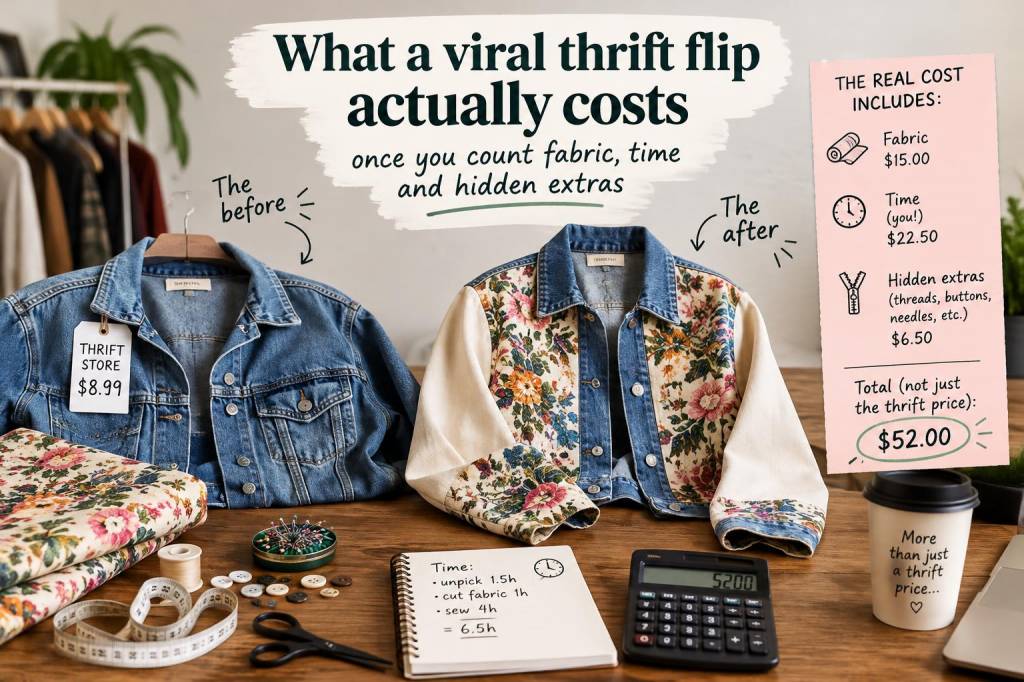
I used to think a viral thrift flip was a pure win: a few dollars for a forgotten jacket, a little paint or stitching, a dramatic before-and-after, and then a satisfying pile of social media praise. It felt like free money with better lighting. Then I started tracking every expense, every hour, and every tiny “extra” that sneaks into a project, and my opinion changed fast. A thrift flip can still be fun, creative, and even profitable, but only if I count fabric, time, and hidden costs instead of only the thrift-store tag.
What surprised me most is that a project can look cheap while quietly becoming expensive. A skirt made from curtains, a jacket covered in patches, or a chair re-covered with a bold print may start with a bargain find, yet the real cost often lives in the middle of the process. Once I began adding thread, interfacing, replacement zippers, paint brushes, glue, shipping, and the value of my own time, the numbers told a very different story. That does not mean thrift flips are a bad idea. It means I finally understood what I was actually paying for.
Why a low thrift price is only a starting point
The sticker price is the easiest number to notice, so it is also the easiest number to overvalue. If I buy a denim jacket for $8, my brain wants to celebrate immediately. But that jacket may need cleaning, patching, new buttons, and an hour of careful sewing. It may also need a seam ripper, stronger needles, fabric dye, or a backup plan when a design idea fails halfway through. Suddenly, that $8 jacket is not just $8 anymore.
I have learned to think of a thrift find as a raw material rather than a finished deal. A low purchase price matters, yet it does not tell me whether a piece is actually worth transforming. A great flip starts with a good base, but a truly cheap base can still be a bad investment if it needs too much rescue work. A stained blazer with damaged lining might be cheaper than a clean one, but the repair bill can erase any savings.
Fabric costs add up faster than people expect
Fabric is one of the biggest hidden expenses because it is easy to underestimate small amounts. I used to buy “just a yard” and think I was being careful. Then I would discover I needed matching material for sleeves, a lining, bias tape, or reinforcement. If I wanted a certain texture or print, I might pay more for a specialty fabric than I spent on the original thrift item.
Even scraps can become expensive when a project depends on exact color matching. If I need a specific shade of black denim or a certain weight of cotton, I may end up buying more than I planned just to avoid a visible mismatch. And if I make a mistake cutting, I pay twice: once for the wasted piece and once for the replacement. That is why I never treat fabric as a tiny side cost anymore. It is part of the core budget.
Here are a few fabric-related costs I now watch closely:
Time is not free, even when I enjoy the process
This is the part many people ignore, especially online. A project can be deeply satisfying and still consume a huge chunk of time. I might spend an evening washing and steaming a garment, another evening removing old stitching, then another measuring, cutting, and pinning, and another fixing mistakes I did not see at first. If I am making content around it, I may spend even longer shooting photos, editing clips, and writing captions.
I enjoy that work, so it can feel strange to call it a cost. But if I am honest with myself, time has value whether I am doing the project for fun, for profit, or for both. A viral flip that takes twelve hours is not equivalent to one that takes one hour, even if both end with impressive photos. When I price a project only by materials, I fool myself into believing I am doing something cheaper than it really is.
I now ask a simple question before starting: Would I still choose this project if no one ever saw it? If the answer is yes, then the time feels more like hobby time. If the answer is no, then I know I am paying for attention, not only for creativity. That distinction matters a lot.
Hidden extras hide in every stage
The sneakiest expenses are usually the ones I forget to record because they feel small in isolation. A dollar here, four dollars there, and suddenly the project crosses a line I did not notice. These extras can turn a bargain flip into a surprisingly costly experiment.
I see them in all kinds of places. Laundry detergent for an extra wash. Gas or transit to reach a store for one missing item. A new tool because my old one breaks. Sandpaper, primer, sealant, or fabric glue. Packaging if I plan to sell or gift the item. Replacement hardware because the original piece was rusted. Even coffee and snacks during a long work session count if I am being truly honest about project spending.
Some projects also come with failure costs. Maybe I choose the wrong paint and need a second coat with a different brand. Maybe the fabric frays more than expected, so I need extra binding. Maybe a thrifted chair needs more repair than I can safely handle, so I pay someone else to fix it. Those moments are normal, but they are still part of the real price.
My simple cost check before I start a flip
To stay realistic, I now break every project into categories. That way I am less likely to trick myself with a cheap starting point. I do not need a complex spreadsheet for every small flip, but I do need a clear list of what I am actually using.
| Category | What I count |
| Base item | Thrift price, shipping, tax |
| Materials | Fabric, thread, paint, glue, hardware, dye, trim |
| Tools | Needles, brushes, blades, sandpaper, replacement parts |
| Prep | Cleaning, washing, steaming, sanding, stripping |
| Labor | My hours, whether I am sewing, repairing, or styling |
| Delivery | Packaging, shipping, travel, storage, listing fees |
Once I see the project laid out this way, I can decide whether I want to continue. Sometimes I still do, because the joy is worth it. Sometimes I stop, because the math says no. Either way, I am choosing with open eyes instead of guessing.
When a viral flip is worth it anyway
Even after all this, I still love a good thrift flip. I just love it for more honest reasons now. Sometimes the value is emotional rather than financial. I might rescue a piece I love, create something unique for myself, or turn a forgotten object into something useful again. If I am making content, a striking transformation can also bring attention, community, and future opportunities. A project that costs more than expected can still be worthwhile if it gives me joy, practice, or a stronger creative voice.
What I avoid now is pretending that a dramatic result means I “made money” just because the base item was cheap. A viral flip is not automatically a low-cost flip. The numbers only make sense when I include everything: materials, time, supplies, mistakes, and all those tiny extras that never show up in the reveal video. When I do that, I feel much more in control, and I can decide whether I am creating for profit, for fun, or for both at once.
Sometimes I still fall in love with an idea before checking the math, and that is part of being creative. But now I know where the money goes, why a project feels bigger than expected, and why a finished piece can be both beautiful and expensive at the same time. The real story is almost never in the thrift-store price tag. It is in everything that happens after I bring it home.