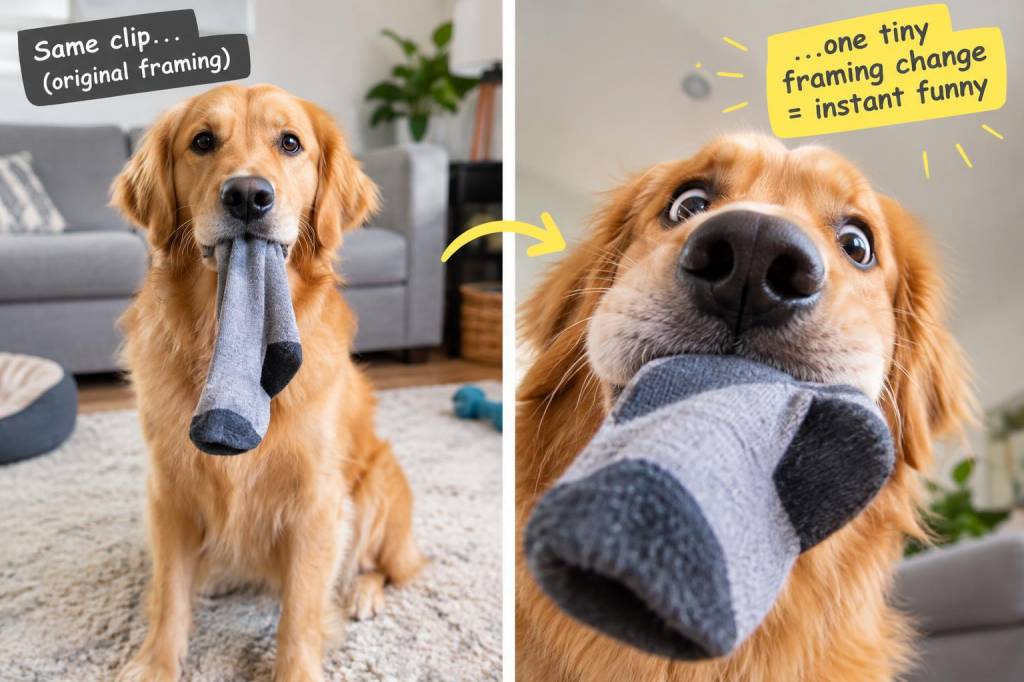
I have a small obsession with pet clips that start out ordinary and become unexpectedly hilarious because of a single framing change. I am not talking about editing in a huge way or adding a circus of sound effects. I mean one tiny shift in where the camera sits, what it includes, and what it accidentally leaves out. That little adjustment can turn a sweet moment into a comedy bit that feels almost professionally timed, even when it was captured by accident on a phone.
When I watch a pet video, I am rarely laughing at what is happening alone. I am laughing at context. A dog doing something serious becomes funny when the frame makes it look tiny and determined. A cat leaping onto a counter becomes funnier when the camera catches the huge empty space around the leap, as if the cat is starring in a dramatic action scene with no budget. Framing changes the emotional read of a clip more than people expect, and once I started noticing that, I could never unsee it.
Why one small framing shift changes everything
Humor often lives in contrast. A pet may be calm, yet the frame may make them look absurdly intense. A pet may be chaotic, yet the frame may make the scene feel strangely elegant. When I move the camera even a few inches, I am not just changing composition. I am changing meaning. The viewer starts interpreting the same behavior in a different way.
Here is what usually happens: the original clip is cute, but not especially funny. Then I reframe it so the pet appears smaller against a larger background, or I crop in closer so a tiny facial expression becomes impossible to ignore. Suddenly, the moment has a punchline. The humor was already there, but the frame gave it a stage.
I think this works because people love seeing animals treated like dramatic characters. A wide frame can make a puppy look like a lone hero facing a giant world. A tighter frame can make a hamster’s serious face feel like a close-up from a prestige film. Our brains are quick to assign personality, intention, and attitude, so when the frame nudges us in one direction, the joke lands faster.
The framing move I use most often
My favorite trick is to leave a surprising amount of negative space around the pet. If a cat is sitting in the corner of a couch, I do not always center the cat. Sometimes I place the cat low in the frame and let the room dominate the shot. That makes the cat look like a tiny executive making a very serious decision in an absurdly large office.
It sounds almost too simple, but this one change often turns a basic pet clip into something that feels more cinematic and more ridiculous at once. A dog staring at an empty wall is mildly amusing. A dog staring at an empty wall while occupying only a small portion of the frame becomes a philosophical event. The room starts to feel like part of the joke.
I also like to frame pets slightly off-center when they are about to do something predictable, because that little imbalance adds tension. A centered pet often feels neat and sweet. An off-center pet feels as if something is about to go wrong in a very entertaining way. Even if nothing happens, the viewer senses comic possibility.
What I look for before I press record
I usually ask myself a few things before I film:
- What part of this moment will look funniest if I leave extra space around it?
- Is there a background object that makes the pet look even more dramatic?
- Would a closer crop make an expression feel sharper?
- Would a wider frame make the pet seem tiny, bold, or unexpectedly lonely?
- Is there a doorway, staircase, chair, or blanket that could make the scene feel more like a setup?
That last one matters a lot. Pets do not need props in the traditional sense, but they do benefit from surroundings that amplify their energy. A dog at the bottom of a staircase looks determined. A cat on top of a refrigerator looks victorious. A rabbit beside a giant toy looks both adorable and slightly overwhelmed. The background is never just background. It is part of the joke.
My favorite kinds of funny framing
There are a few framing styles I keep returning to because they reliably improve a pet clip without making it feel forced.
| Framing style | What it does | Why it works |
|---|---|---|
| Wide shot with small subject | Makes the pet look tiny in a large space | Adds scale, irony, and a little dramatic loneliness |
| Tight crop on face | Highlights expression and eye movement | Turns a subtle look into a strong punchline |
| Low angle | Makes the pet seem powerful or theatrical | Gives even a silly pose unexpected importance |
| Off-center placement | Creates imbalance and visual tension | Makes the viewer feel like something amusing is about to happen |
| Frame-within-a-frame | Uses doorways, furniture, or mirrors | Makes the scene feel staged in a playful way |
The frame-within-a-frame trick is especially fun. If I catch a pet through a doorway or between chair legs, the scene instantly feels more deliberate than it actually was. That little layer of visual structure can make a regular dog nap look like a museum exhibit or a cat’s suspicious pause look like a courtroom reveal.
Why close-ups work so well on pets
Close-ups are powerful because pets are masters of micro-expression. A tiny ear tilt, a blink, a slow head turn, or a suspicious nose twitch can carry the whole joke. If I zoom in too much, I can lose context, but if I crop just enough, the face becomes the whole story.
One of my favorite things is when a pet looks deeply unimpressed by something, and I frame it so that unimpressed look fills the screen. That is comedy gold. The viewer is not just watching an animal; they are watching a judgmental little actor delivering a silent review. A well-timed close-up can transform a harmless moment into pure attitude.
Still, I do not crop every clip tightly. If the pet is already being physically ridiculous, I often keep more room around them so the absurdity breathes. A tight crop says, “Look at this expression.” A wider crop says, “Look at this entire situation.” Both can be funny, but they create different flavors of humor.
What I avoid when I want the clip to stay funny
I have learned that some framing choices flatten the humor instead of sharpening it. If I center everything too neatly, the clip can feel too polished. If I zoom too hard, I can lose the weird little details that make the moment charming. If I follow the pet too closely, I sometimes erase the pause or delay that gives the joke its rhythm.
That rhythm matters more than people think. Funny pet clips often depend on a beat: a glance, a pause, a second of confusion, a tiny movement after stillness. I try to frame in a way that lets that beat land. If I am too eager, I miss the joke. If I am patient, the joke often appears on its own.
I also avoid framing that hides the pet’s body language. A tail flick, paw placement, or awkward crouch may be what makes the clip hilarious. If I crop only the face and lose the posture, I may lose half the comedy. The funniest pet moments often live in the full little performance, not just the face.
When the background becomes part of the punchline
Sometimes I do not even need the pet to do much. A cat sitting in front of a giant decorative plant can look like it is guarding a secret jungle temple. A dog standing near a pile of laundry can look like it has conquered an entire kingdom of fabric. In those moments, I frame to exaggerate the comparison between the pet and the environment.
That contrast is especially useful when the pet is tiny. A small animal against a big room can feel like an underdog story, which is already amusing. A massive dog squeezed into a small chair can become a visual joke before it even moves. The frame tells the audience what kind of joke they are about to receive.
Sometimes I even tilt the phone slightly, not enough to look messy, but enough to give the scene a little extra comic unease. A barely off-kilter frame can make a pet look like it has entered a universe where everything is just a bit weird. That sensation can make an ordinary clip feel more playful and memorable.
The tiny change I rely on most when a clip feels flat
If a pet clip feels flat, I do one thing first: I step back or move in, depending on what the moment needs. That is usually enough. Either I give the pet more room to become a tiny absurd figure in a huge environment, or I bring the frame closer so the expression becomes undeniable. I do not need a complicated edit. I need a better decision about space.
That is what makes this so satisfying to me. The difference between “cute” and “laugh-out-loud funny” can be almost embarrassingly small. A few inches. A slightly lower angle. A little more ceiling. A little less floor. The pet stays exactly the same, yet the viewer experiences the moment completely differently.
I love that kind of magic because it feels accessible. Anyone with a phone can try it. Anyone can look at a pet clip and ask, “What if I moved this just a little?” That question alone can unlock a much funnier result than any fancy filter ever could.