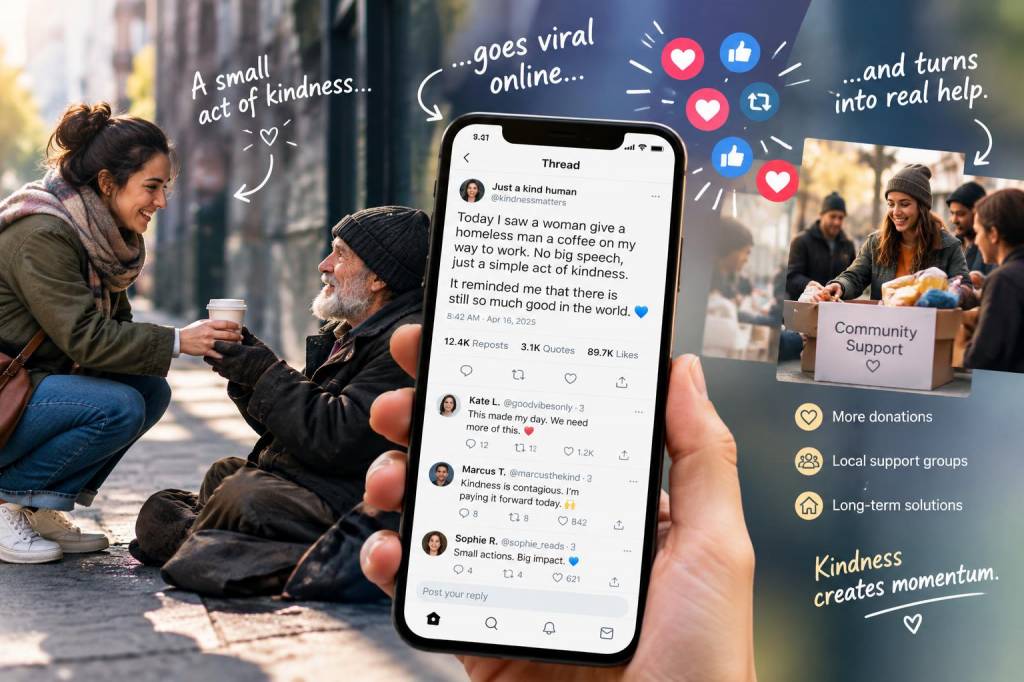
I remember the exact bench where it happened: a rainy Thursday, someone handed a shivering woman a hot coffee they'd just bought. I wasn't looking for a story, but I was looking — phone in hand, the kind of tiny detective who notices sparks of humanity in the everyday. That simple gesture became the seed of a thread that blew up, not because I chased clout, but because I shaped the moment into something people could *feel* and *act* on.
Why a random street kindness can become more than a feel-good scroll
People crave connection. When we see someone doing good without asking for anything in return, it taps into a deep, hopeful part of us. A story that captures that authenticity can spread quickly because it promises two things: a reminder that the world isn't all bad, and an easy way to be part of the solution. But virality isn't magic — it's craft. You can take a spontaneous act and turn it into a viral thread that drives real help if you approach it thoughtfully.
Spot the moment — what to look for
Not every nice thing will translate to a thread that moves people. Here’s how I decide whether to post:
How I craft the thread — structure that works
Threads that move people share a rhythm: quick attention-grab, human detail, widening perspective, clear invitation to act. Here's my go-to structure:
Crafting the visuals and captions
Good visuals make a thread scroll-stopping. If you can snap a short video or a clear photo, do it — but prioritize dignity. Zoom in on hands, the coffee cup, a warm smile rather than the person's vulnerable state.
Make it useful — turn emotion into action
Virality without follow-through is fleeting. If you want the thread to drive real help, pair the emotion with usable options:
Ethics and consent — the rules I live by
This is critical. The best threads uplift people without exploiting them. My ethics checklist:
Timing and platform strategy
Different platforms reward different formats. I usually start on the platform where my community is strongest, then cascade.
Amplify responsibly — who to tag and how
Tagging the right accounts can boost reach, but don't spam. My tactic:
Follow through — the thing that makes your thread credible
People will ask, "What happened next?" If you don't follow up, the thread fades into performative territory. I make it a rule to:
Examples that inspired me
One thread I ran started with a single image of a kid handing a box of leftover pizza to a sanitation worker. I quoted the kid saying, "He was hungry." Within 24 hours, people had donated to a local food pantry and a nearby pizza place began a "pay it forward" pizza board. It wasn't about me — it was about connecting a scene to real, local action.
Practical checklist before you hit publish
| Is consent obtained (if needed)? | Yes / No |
| Is the narrative clear in one or two lines? | Yes / No |
| Is there a concrete call to action? | Yes / No |
| Have you linked or tagged any verified local resources? | Yes / No |
| Will you follow up within 48 hours? | Yes / No |
Turning a random act of kindness into a viral thread that actually helps takes a mix of sensitivity, storytelling, and logistics. When done right, it doesn't just make people feel good — it catalyzes actions that add up. So next time you witness a small, beautiful moment on the street, think like a curator: capture the humanity, respect the people involved, and give readers a simple way to join in. You'll be amazed at how quickly a single cup of coffee can ripple into change.