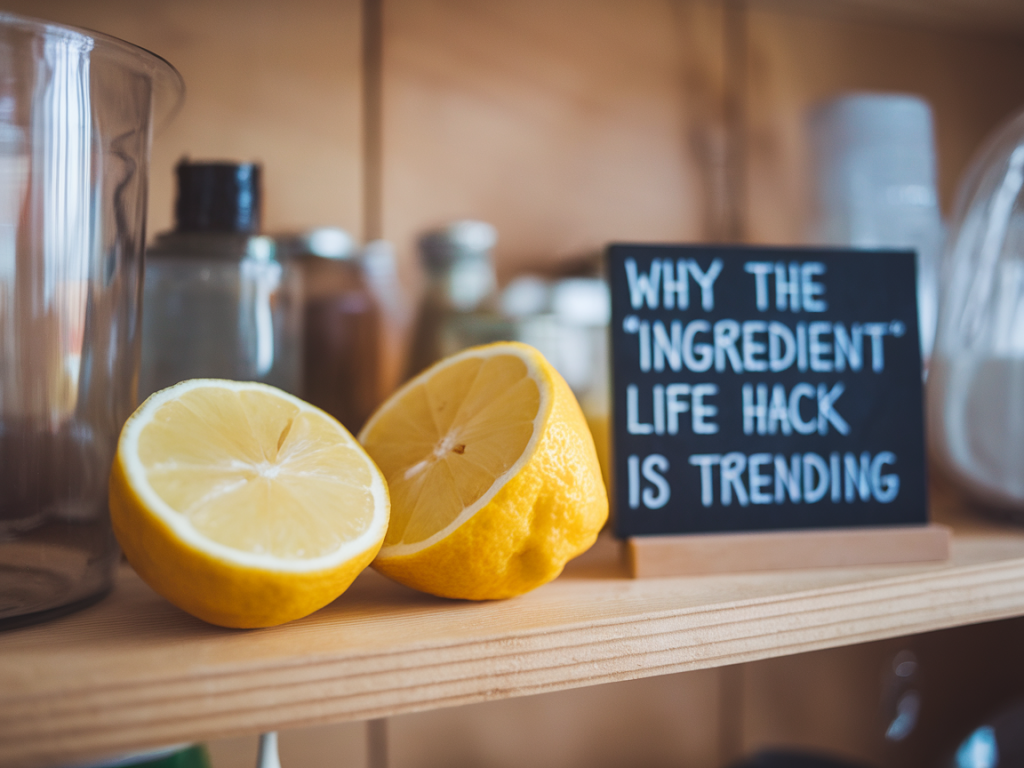
I first noticed the “one ingredient” life-hack trend when my feed started filling up with short clips of people solving everyday problems with one pantry item and a wink. No fancy gadgets, no multistep rituals — just a single, familiar product doing something unexpectedly useful. It felt like a breath of fresh air: approachable, satisfying, and oddly soothing in a world full of viral overcomplication. So I started testing a few myself, and quickly realized why this trend has stuck around.
Why one-ingredient hacks hit so hard
There are a few reasons these hacks resonate so well right now. First, simplicity sells. In 15 seconds you can watch someone rescue a stained shirt with baking soda, deodorize shoes with tea bags, or polish chrome with olive oil. That instant payoff is irresistible.
Second, familiarity breeds trust. When the “tool” is something you already own — like vinegar or toothpaste — you’re more likely to try it than some obscure product recommended by an influencer. There’s comfort in using a household staple with a new purpose.
Third, platforms reward snackable, repeatable content. Algorithms favor short videos that get rewatches and shares. One-ingredient hacks are easy to demonstrate visually, easy to replicate, and get tried by viewers who then post their own results, creating a feedback loop.
And finally, there’s a DIY, anti-waste ethos underneath it all. Using an existing item for a second purpose feels resourceful and thrifty. It’s the small-win mindset: little hacks that make life marginally easier add up to more cheer in your day — which is exactly why I post them on Wiralclub.
Household staples that actually work — and how I use them
I’ve experimented with loads of suggestions, some surprising and some disappointingly ineffective. Below are the staples I keep reaching for, with the specific tricks that actually deliver results in my home.
| Staple | Common uses | Pro tips / cautions |
|---|---|---|
| Baking soda | Deodorize carpets, scrub sinks, remove stains | Make a paste for scrubbing; test fabric first to avoid fading |
| White vinegar | Descale kettles, deodorize, disinfect hard surfaces | Don’t mix with bleach; dilute for delicate surfaces |
| Lemon | Brighten whites, remove odors, shine copper | Avoid on stone (marble/granite) — acidity can etch |
| Olive oil | Polish wood and stainless steel, remove sticky labels | Use sparingly to avoid greasy buildup |
| Toothpaste (non-gel) | Polish silver, remove scuffs from shoes | Non-gel for abrasion; rinse thoroughly |
| Coffee grounds | Deodorize fridge, natural abrasive for pots | Can stain porous surfaces — bag or rinse well |
My favorite one-ingredient wins
- Baking soda in the fridge: I keep a small open box in the back of my fridge and it really does knock down odors. If something smells particularly funky, I sprinkle baking soda in a bowl and let it sit overnight. Simple and effective.
- Vinegar + water for streak-free windows: I used to buy expensive glass cleaner until I realized a 1:1 mix of white vinegar and water does the job just as well. It’s cheap and streak-free when I wipe with a microfiber cloth.
- Toothpaste on silver jewelry: A pea-sized dab on a soft cloth removes tarnish faster than some store polishes. It’s a gentle abrasiveness that brings back shine without needing a special kit.
- Lemon on cutting boards: Half a lemon rubbed across a wooden board works wonders at removing lingering garlic or onion smells. I follow with a salt scrub if it needs a deeper clean.
- Olive oil for squeaky drawers: A drop or two along drawer slides smooths things out immediately — just don’t overdo it or you’ll get oily fingerprints.
What actually doesn’t work — or needs care
Not every one-ingredient idea is a keeper. I learned the hard way with a few bold experiments:
- Hydrogen peroxide on colorful fabrics: It bleaches. Great for whites, disastrous for anything else.
- Baking soda paste on delicate leather: It dries out leather and can cause cracking. Leather deserves leather-specific products.
- Vinegar on natural stone: I tried this on a marble countertop once and regretted it — acid etches stone. Big no.
So part of the one-ingredient appeal is that it feels low-risk — but that doesn’t mean no risk. A quick spot test on an inconspicuous area, a little online reading, or a moment’s common sense can save you from a ruined shirt or countertop.
How to judge if a one-ingredient hack is worth trying
Before I try anything viral, I ask three quick questions:
- Is the material safe for the surface or fabric I’m treating?
- Is the result reversible or low-risk if it goes slightly wrong?
- Does it save time, money, or both compared to the usual method?
If the answers check out, I give it a go. If not, I move on — there are always dozens of other hacks waiting to be tested.
Sharing and iterating — why the trend keeps evolving
One reason this format thrives is that people don’t just copy — they tweak. Someone shows vinegar cleaning a kettle; someone else shows mixing it with lemon for extra zing. These small iterations get re-shared and refined until you’ve got dozens of micro-versions of the same principle.
That’s part of the fun for me as a curator: spotting the tiny change that makes a hack actually useful and sharing it so readers don’t waste time on the dud versions. It’s also why community comments and user-submitted fixes are gold — often the best tips come from readers who tried it and improved the method.
Try one tonight
If you want a quick experiment, pick one of the staples in the table and try a simple, low-risk hack: deodorize a smelly container with baking soda, or shine a piece of jewelry with toothpaste. Snap a before-and-after photo — those little victories feel great — and if it works, tell someone. That’s how this little movement spreads: one humble success at a time.